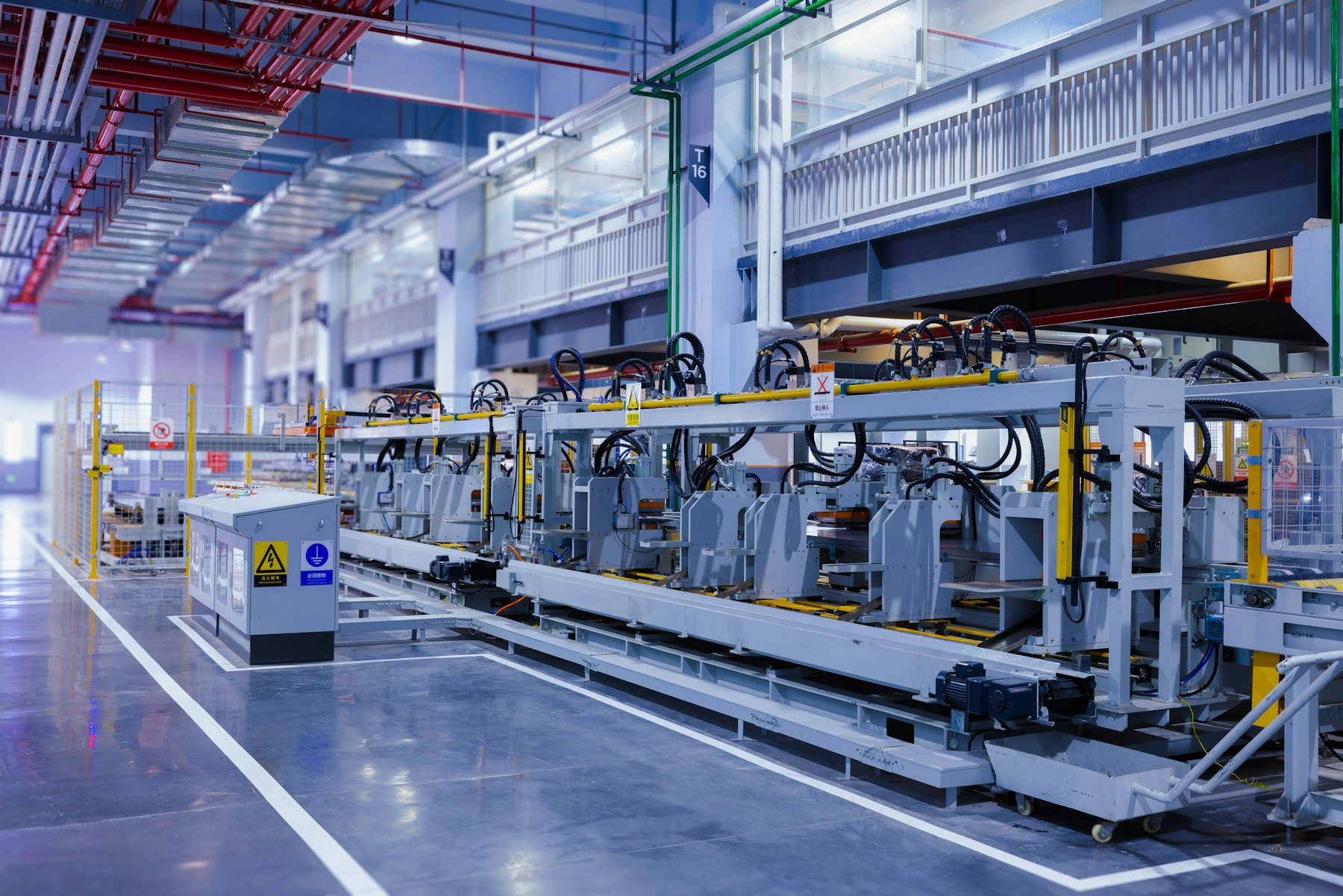
Manufacturing and assembly
Factory lighting is set by the finest task on the line. The level, direction and colour quality of the light all affect accuracy, output and safety.
What decides the design
- Level set by the task
- Requirements rise with the detail of the work, from 200 lux for rough assembly to 750 lux for precision work and inspection.
- Rotating machinery
- Lighting that flickers can make rotating parts appear stationary. Drivers are specified for low flicker and low stroboscopic effect wherever machines turn.
- Shadows and direction
- Overhead plant, cranes and the operator's own body cast shadows. Luminaire positions are planned around obstructions, with local task lighting where it is needed.
- Environment
- Dust, oil mist, heat and wash-down determine the ingress protection rating and the materials of the fitting.
Light levels
200 to 750 lux, set by the finest task on the line. The full list for this sector:
| Task or area | Lux | UGR limit | Uniformity | Ra |
|---|---|---|---|---|
| Rough assembly work | 200 | 25 | 0.60 | 80 |
| Medium assembly work | 300 | 25 | 0.60 | 80 |
| Fine assembly work | 500 | 22 | 0.60 | 80 |
| Precision assembly work | 750 | 19 | 0.70 | 80 |
| Welding | 300 | 25 | 0.60 | 60 |
| Rough and average machining, tolerances of 0.1 mm or more | 300 | 22 | 0.60 | 60 |
| Precision machining and grinding, tolerances under 0.1 mm | 500 | 19 | 0.70 | 60 |
| Scribing, inspection | 750 | 19 | 0.70 | 60 |
Later editions of the standard revise some values. How to read these figures