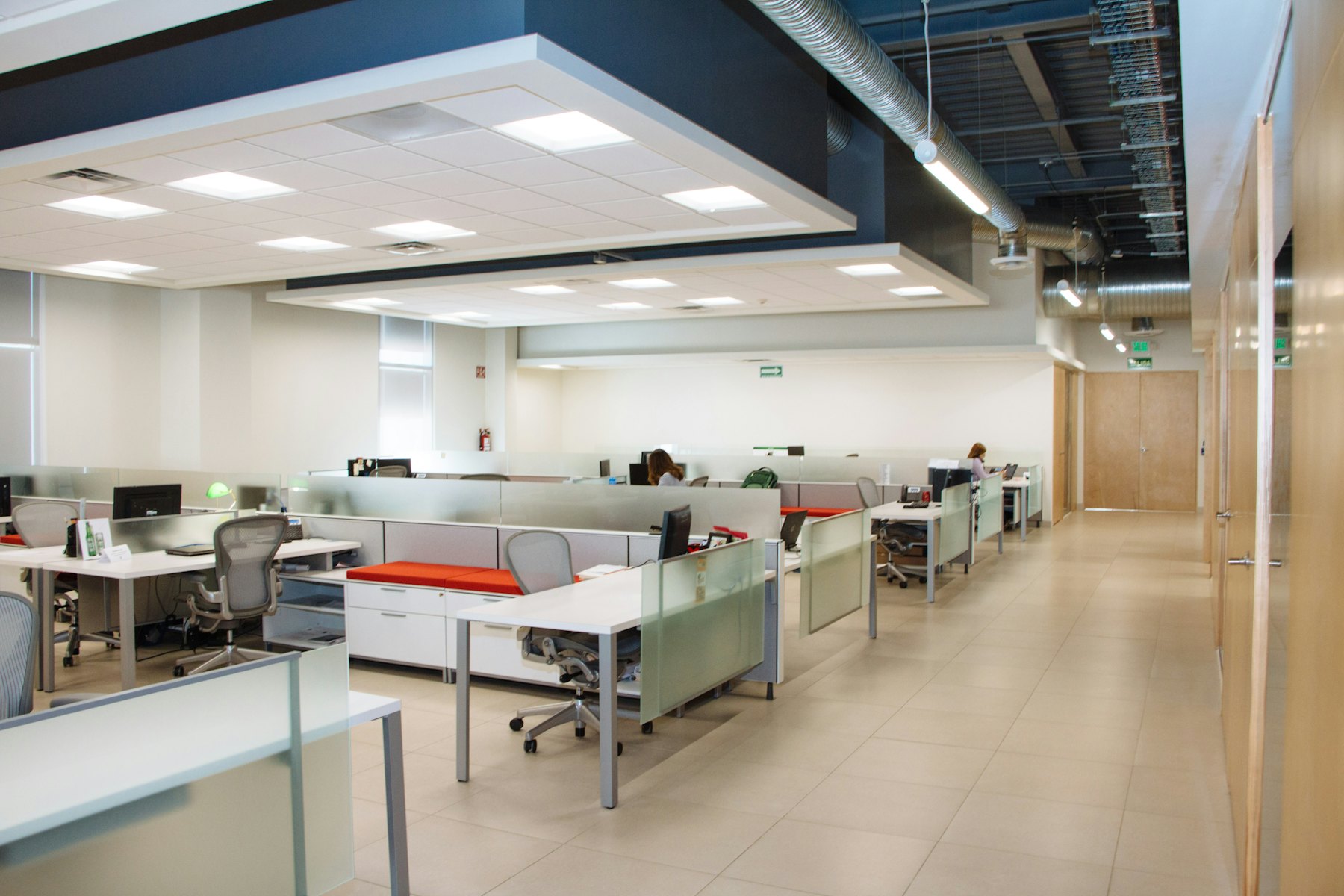
Offices
Office lighting has to support screen work for a full day without glare, and switch itself off when the floor is empty.
What decides the design
- Glare control
- Screen-based work needs luminaires with a unified glare rating of 19 or below and controlled brightness at high angles, so that fittings do not reflect in monitors.
- Light on walls and ceilings
- A room lit only at desk level feels dim however many lux fall on the desk. Guidance for offices asks for light on walls and ceilings as well as on the working plane.
- Daylight and occupancy
- Perimeter zones can dim for most of the day. Absence detection in cellular offices and meeting rooms removes the largest source of waste.
- Flexibility
- Layouts change. A regular array on addressable controls can be re-zoned without rewiring.
Light levels
500 lux at the desk, glare limited to UGR 19. The full list for this sector:
| Task or area | Lux | UGR limit | Uniformity | Ra |
|---|---|---|---|---|
| Filing, copying | 300 | 19 | 0.40 | 80 |
| Writing, typing, reading, data processing | 500 | 19 | 0.60 | 80 |
| CAD workstations | 500 | 19 | 0.60 | 80 |
| Technical drawing | 750 | 16 | 0.70 | 80 |
| Conference and meeting rooms | 500 | 19 | 0.60 | 80 |
| Reception desk | 300 | 22 | 0.60 | 80 |
| Archives | 200 | 25 | 0.40 | 80 |
Later editions of the standard revise some values. How to read these figures