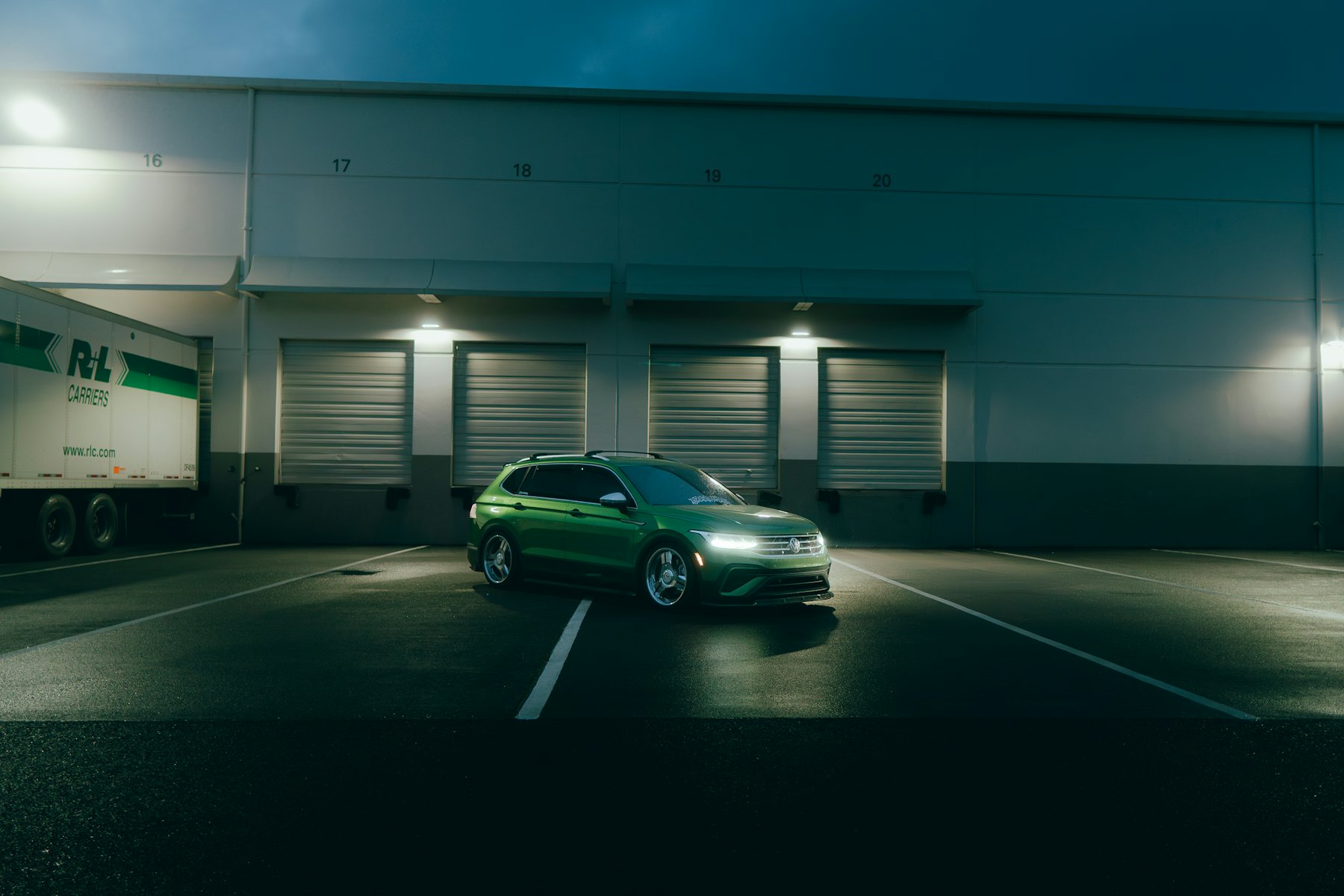
Yards and loading bays
External working areas mix vehicles and pedestrians after dark. The lighting has to make each visible to the other without spilling light beyond the site.
What decides the design
- Vehicle and pedestrian routes
- Crossing points, loading doors and turning areas need more light and better uniformity than open hardstanding.
- Obtrusive light
- Light above the horizontal and onto neighbouring property is limited by ILP guidance, and usually by a planning condition. Flat-glass luminaires aimed downward are the starting point.
- Transition at dock doors
- Drivers and loaders move between a bright interior and a dark yard. Lighting the dock apron and the inside of trailers reduces the step in adaptation.
- Columns and access
- Column positions have to survive vehicle movements. Mounting height trades uniformity against spill and maintenance access.
Light levels
5 to 50 lux outdoors, by type of traffic. The full list for this sector:
| Task or area | Lux | GR limit | Uniformity | Ra |
|---|---|---|---|---|
| Walkways exclusively for pedestrians | 5 | 50 | 0.25 | 20 |
| Traffic areas for slowly moving vehicles, up to 10 km/h | 10 | 50 | 0.40 | 20 |
| Regular vehicle traffic, up to 40 km/h | 20 | 45 | 0.40 | 20 |
| Pedestrian passages, vehicle turning, loading and unloading points | 50 | 50 | 0.40 | 20 |
Later editions of the standard revise some values. How to read these figures